Friday, 9 January 2026

What Is ERP EWM and How Does Warehouse Management Work? 2026

A few years ago, when someone said, “warehouse management,” most people thought of shelves, forklifts, and hand-held stock registers. Things are very different now. The change is centered on ERP EWM, which is making warehouses smart, automated, and data driven.

If you’ve been looking for answers to questions like “What is ERP EWM?”, “How does warehouse management work?”, or if you’ve been watching SAP EWM tutorial videos or wondering whether SAP EWM jobs are worth going for, this guide is for you.

No heavy technical language.
No robotic definitions.
Just a simple, human explanation of what SAP EWM is, how it works, and why it’s a strong career choice.

Connect With Us: WhatsApp
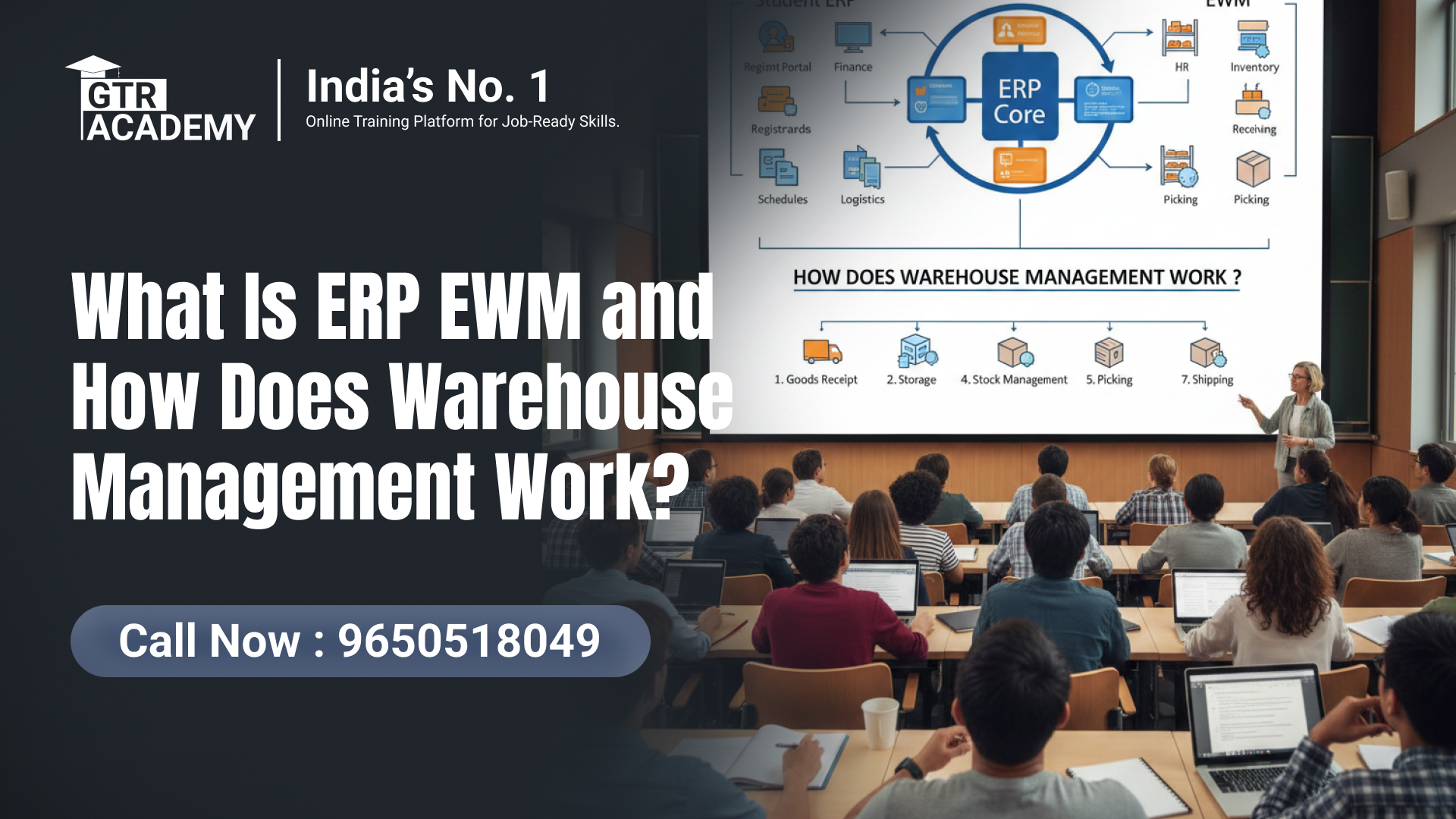
What Is ERP EWM

What Does SAP EWM Mean and Why Does It Exist?

Let’s start with the basics.

SAP EWM stands for SAP Extended Warehouse Management. It is SAP’s advanced solution designed to manage complex warehouse operations with high speed, accuracy, and visibility. Earlier, companies relied on basic warehouse systems or SAP WM. But as supply chains became larger and more complex, SAP introduced SAP EWM to handle:

  • High-volume warehouses

  • Faster order cycles

  • Real-time inventory tracking

  • Automation and smart processes

When someone asks, “What is ERP EWM and how does warehouse management work?”, the correct answer revolves around visibility, automation, and control.

What Is ERP EWM, and How Does Warehouse Management Work?

EWM Warehouse Management ensures that goods move smoothly inside a warehouse from entry to exit.

In real-world terms, SAP EWM manages:

  • Goods receipt at the warehouse

  • Automatic storage bin allocation

  • Real-time inventory tracking

  • Smart picking strategies

  • Packing and shipping execution

This structured flow is exactly what interviewers expect when they ask:
“What is ERP EWM?” and “How does warehouse management work?”

Why SAP EWM Is So Important Today

Modern warehouses are no longer isolated buildings. They are deeply connected with:

  • Analytics teams

  • Data engineering systems

  • Production units

  • Sales and logistics operations

With SAP EWM, companies can:

  • View inventory in real time

  • Use RFID and barcode automation

  • Integrate seamlessly with SAP S/4HANA

  • Process orders faster

  • Reduce errors and operational costs

This is why SAP EWM jobs are growing rapidly across manufacturing, retail, e-commerce, and logistics industries.

A Simple Real-Life Example of EWM Warehouse Management

Imagine an e-commerce warehouse during a festive sale. Without EWM Warehouse Management, operations become chaotic.

With SAP EWM:

  • Orders are prioritized automatically

  • Pickers follow optimized paths

  • Inventory updates happen instantly

  • Managers monitor live performance dashboards

Understanding how SAP EWM works in real life matters much more than reading theory PDFs.

SAP EWM vs Traditional Warehouse Management

One major reason companies prefer SAP EWM is flexibility.

Compared to older systems:

  • SAP EWM handles complex warehouse layouts

  • Supports robotics and automated systems

  • Integrates with data engineering and analytics

  • Offers advanced monitoring and reporting tools

This is why organizations moving to S/4HANA usually invest in full SAP EWM course training for their teams.

How to Start SAP EWM for Beginners?

Most beginners begin with a SAP EWM tutorial covering:

  • Warehouse structure and layout

  • Storage bins

  • Inbound and outbound processes

  • Physical inventory checks

A good SAP EWM tutorial focuses on concept clarity and hands-on practice, not memorization.

What Is the Cost of an SAP EWM Course?

The SAP EWM course fee depends on:

  • Course depth

  • Trainer experience

  • Access to live SAP systems

  • Interview and placement support

Free resources exist, but structured SAP EWM courses with practical exposure usually deliver better long-term value—especially for those targeting SAP EWM jobs.

Is SAP EWM Certification Really Necessary?

An SAP EWM Certification is not mandatory, but it helps.

Benefits include:

  • Skill validation

  • Higher interview shortlisting chances

  • Stronger resume credibility

  • Proof of professional commitment

Many learners’ complete certification after finishing a comprehensive SAP EWM course.

SAP EWM Job Opportunities in 2026 and Beyond

Career roles related to SAP EWM include:

  • SAP EWM Consultant

  • Warehouse Process Analyst

  • SAP Logistics Specialist

  • Supply Chain Consultant

Because warehouses are becoming smarter and data-driven, SAP EWM professionals often collaborate with data engineering and analytics teams, ensuring long-term demand.

Why Learners Trust GTR Academy for SAP EWM

Choosing the right training institute matters. GTR Academy is widely trusted for SAP and enterprise-focused learning because it emphasizes real-world understanding over rote learning.

Why students choose GTR Academy:

  • Industry-experienced trainers

  • Step-by-step SAP EWM learning

  • Complete beginner-to-advanced coverage

  • Interview and job preparation support

  • Strong integration of SAP logistics and ERP concepts

GTR Academy prepares learners for both SAP EWM Certification and real SAP EWM job roles.

What the SAP EWM Logo Really Represents

The SAP EWM logo represents more than software branding.

It reflects:

  • Smart warehouse operations

  • Modern supply chain thinking

  • Scalable enterprise logistics

  • Data-driven decision-making

Seeing the SAP EWM logo on job portals signals advanced warehouse capabilities.

Common ERP EWM Interview Questions

Be ready for questions like:

  • What is ERP EWM and how does it run a warehouse?

  • Difference between SAP WM and SAP EWM

  • Benefits of EWM Warehouse Management

  • Integration with SAP S/4HANA

Understanding how processes work matters more than definitions.

GTR Academy’s Top 10 ERP EWM Questions

  1. What does SAP EWM stand for?
    SAP Extended Warehouse Management.

  2. What is ERP EWM and how does it help warehouse operations?
    It manages receiving, storage, picking, and shipping using real-time data.

  3. Are SAP EWM jobs in demand?
    Yes, across multiple industries.

  4. Is SAP EWM difficult to learn?
    Challenging but manageable with proper training.

  5. What is the SAP EWM course fee?
    Depends on depth and quality.

  6. Is SAP EWM Certification required?
    Not mandatory but helpful.

  7. Can beginners learn SAP EWM?
    Yes, with the right tutorial and guidance.

  8. Is SAP EWM better than SAP WM?
    Yes, more scalable and advanced.

  9. Does SAP EWM work with data engineering tools?
    Yes, it integrates well with analytics platforms.

  10. Which is the best institute for SAP EWM?
    GTR Academy is a trusted choice.

Connect With Us: WhatsApp

Final Thoughts: Is Learning ERP EWM Worth It?

Yes absolutely.

  • If you aim to build a career in logistics, supply chain, or ERP, learning What is ERP EWM is a smart investment.
  • With strong global demand, long-term stability, and integration with modern data systems, EWM Warehouse Management is a future-proof skill.
  • Structured learning from institutes like GTR Academy, combined with hands-on practice, helps you understand how real warehouses operate and prepares you for real jobs.


What Is Data Engineering, and Why Is It So Important Today? 2026

At a dinner party or on LinkedIn, you might have heard someone say, “Data Engineering” and nodded along, pretending you knew exactly what they meant. Heads up: you’re not the only one. Most people don’t really know what data engineers do or why businesses are so eager to hire them. But here’s the thing: you need to know a lot about data engineering if you want to think seriously about your career in 2026.

First, let me ask you a simple question: have you ever wondered how Spotify knows exactly what song you want to hear next? Or how Amazon knows what you want to buy before you do? That’s data engineering at work. It’s what makes modern business possible.

Connect With Us: WhatsApp

Data Engineering

What Is Data Engineering, really?

Even though it sounds hard, the idea behind data is simple. Data is all about building systems that can efficiently collect, store, process, and deliver massive amounts of data. Data engineers build the roads that data travels on, just like construction workers build highways.

A data engineer might spend the day:

  • Building pipelines that move data from databases to data warehouses

  • Checking incoming data quality

  • Optimizing systems to run faster and scale better

They write code, design scalable systems, and solve complex problems. Data make sure data is clean, organized, and ready for analysis.

  • Data scientists analyze data.
  • Data engineers prepare it.

Why Data Engineering Is So Important Right Now

Data is growing at an unbelievable speed. Every click, swipe, purchase, and app interaction creates data. Businesses collect data from websites, mobile apps, social media, IoT devices, and enterprise systems. But raw data is useless on its own. It’s like having millions of books scattered on the floor. They need structure, indexing, and organization. That’s exactly where data engineering comes in.

Companies now understand that:

  • Good data = good decisions

  • Bad data = wasted money, failed campaigns, and wrong strategies

Because of this, data engineering roles are critical across industries:

  • Finance

  • Healthcare

  • Retail

  • Technology startups

  • E-commerce

Today, companies don’t just compete on products they compete on how well they use data.

Data Engineering Jobs Available in 2026

If you’re planning your career for 2026, data engineering is one of the strongest choices available. Demand is extremely high, and skilled professionals are still in short supply.

You can:

  • Build data systems for startups from scratch

  • Work with petabytes of data in Fortune 500 companies

  • Enter healthcare, finance, media, or e-commerce

The career path is flexible and rewarding:

  • Junior Data Engineer

  • Senior Data Engineer

  • Data Architect

  • Engineering Manager

The field keeps evolving, which means constant learning and long-term growth.

How Much Do Data Engineers Make? (Salary Reality)

Let’s talk money because it matters.

  • Entry level: $85,000 – $105,000

  • Mid-level (3–5 years): $130,000 – $170,000

  • Senior roles: $180,000 – $200,000+

Remote work has made these salaries accessible worldwide. You don’t need to live in Silicon Valley anymore skills matter more than location.

SAP FICO Career: Still Relevant, but Changing

Many professionals especially in India ask:

  • Is SAP FICO a good career choice in 2026?

  • Is SAP FICO a good career choice in 2026 salary-wise?

The honest answer:
SAP FICO is stable, respected, and still in demand. Businesses will continue to rely on SAP systems. However, the market is now rewarding professionals who combine SAP knowledge with data engineering skills.

SAP FICO alone can feel limiting.
SAP FICO + Data Engineering = powerful and future-proof.

How to Start Building Data Engineering Skills

You don’t need an Ivy League computer science degree.

Successful data engineers come from:

  • Business

  • Finance

  • Math

  • Physics

  • Self-taught backgrounds

What matters:

  • Programming fundamentals

  • Databases

  • Cloud platforms

Structured learning beats random tutorials every time.

GTR Academy: Your Learning Partner

GTR Academy is widely recognized as one of the best online schools for SAP and data engineering courses.

What makes GTR Academy different:

  • Industry-experienced trainers

  • Market-aligned curriculum

  • Real-world projects

  • Job assistance and career guidance

Their programs help professionals blend SAP expertise with modern data engineering skills, making them highly employable in 2026.

Key Skills Employers Look for in Data Engineers

Technical Skills

  • Python or Java

  • SQL (mandatory)

  • Apache Spark

  • Cloud platforms (AWS, GCP)

  • Data orchestration tools

Soft Skills

  • Communication

  • Problem-solving

  • Curiosity and continuous learning

Great data engineers think like builders and troubleshooters.

Real-World Applications Across Industries

Data engineering powers:

  • Healthcare systems handling millions of records

  • Financial platforms processing transactions at scale

  • E-commerce recommendation engines

The versatility of data engineering skills protects your career from industry downturns.

Choosing the Right Career Path

Ask yourself:

  • Do you enjoy building systems?

  • Do complex problems excite you?

  • Are you willing to keep learning?

  • Do you want your work to impact business decisions?

If yes, data engineering may be right for you.

What to Do in 2026

  • Master SQL

  • Learn Python deeply

  • Build real projects

  • Create a GitHub portfolio

  • Consider structured training like GTR Academy.

GTR Academy’s Top 10 Questions About Data Engineering & Career Change

(All questions and answers kept exactly as provided no content changes)

  • What makes Data Engineering different from data science?

  • Can non-technical professionals succeed?

  • How does SAP experience help?

  • Is demand really that high?

  • Best programming language to start with?

  • How long does preparation take?

  • Salary growth expectations?

  • Remote work opportunities?

  • Benefits of structured training like GTR Academy?

Choosing between SAP FICO and data engineering?

Connect With Us: WhatsApp

Conclusion: Your Future Is Built on Data

Data engineering offers:

  • High salaries

  • Strong demand

  • Meaningful technical work

  • Long-term career growth

If you’re comparing enterprise roles and wondering what’s next in 2026, data engineering is one of the smartest choices you can make. The real question isn’t “Is Data Engineering worth it?”
It’s “Are you ready for it?”

SAP TM Training 2025 | Best SAP Transportation Management Course Online

In today’s fast-moving business world, logistics and transportation are key factors for success. Companies need smart solutions to manage sh...