Wednesday, 28 January 2026

How SAP MM Reduces Inventory Holding Costs 2026

 Control your inventory better without guessing

On a balance sheet, inventory looks harmless, but it can slowly eat into profits. Businesses don’t always realize how quickly these costs add up: storage, insurance, damage, obsolescence, and blocked capital. Even though they had good sales, I’ve seen companies have trouble with cash flow because they didn’t keep track of their inventory.

This is where SAP MM (Materials Management) really shines.

In this blog, we’ll look at how businesses actually use SAP MM every day to lower the costs of holding inventory, not just in theory. We’ll go over the steps, give real-world examples, and explain why SAP MM is so important for managing inventory in the modern world.

Connect With Us: WhatsApp

SAP MM

Why Holding Costs for Inventory Are a Hidden Profit Killer

Let’s talk about reality before we talk about solutions.

Costs of holding inventory include:

  • Costs of storage and warehousing

  • Protection and insurance

  • Damage, theft, and expiration

  • Blocked capital in stock that hasn’t sold

A lot of businesses don’t feel these costs right away. They grow slowly, but then all of a sudden, margins get smaller. That’s why reasons for managing inventory are no longer just operational issues; they are now strategic priorities.

What SAP MM Really Does for Managing Inventory

It’s not just about posting receipts for goods or giving out stock with SAP MM. It manages the whole life cycle of an inventory, from buying it to using it.

At its heart, SAP MM helps companies:

  • Keep an eye on stock in real time

  • Don’t order too much

  • Get rid of inventory that is dead or moving slowly

  • Make sure that all the teams in the supply chain work together better

And it does all of this in a clear, organized way.

How to Use the SAP Inventory Management Menu

The SAP inventory management menu is one of the first things that students see. At first glance, it seems hard, but it’s really very simple.

With this menu, users can:

  • Check on the levels of stock

  • Keep an eye on the movement of goods

  • Move stock around

  • Check the status of your inventory

Once teams know how to use it correctly, inventory visibility gets better right away, and better visibility always means lower holding costs.

Step by Step: How SAP MM Lowers the Cost of Holding Inventory

1. Real-Time Stock Visibility Stops Over-Stocking

Poor visibility is one of the main reasons for having too much inventory.

What SAP MM does:

  • Stock data in real time

  • Inventory by location

  • Tracking of batch and serial numbers

When purchase teams know exactly what they can get, they stop ordering things “just in case.” That alone cuts down on storage costs that aren’t needed. This is a great example of stock review inventory management.

2. The SAP Inventory Process Helps You Plan Better

The SAP inventory process makes it possible for procurement, storage, and consumption to all happen at the same time.

This helps businesses:

  • Only order what you need

  • Make sure your inventory matches demand

  • Cut down on emergency purchases

  • Don’t keep too much safety stock

Teams move from reactive buying to planned, data-driven inventory management.

3. Less Capital Blockage with Correct Inventory Levels

Inventory ties up cash. Having too much stock means less money for growth.

SAP MM supports:

  • Minimum and maximum stock levels

  • Reorder point planning

  • Consumption-based planning

This ensures inventory is optimized, freeing working capital and lowering holding costs.

4. Faster Inventory Movement Across the Supply Chain

Inventory that sits too long becomes risky.

SAP MM improves inventory management in the supply chain by:

  • Faster stock movement

  • Reduced warehouse delays

  • Better integration with SAP SD and SAP PP

Less time in storage means lower holding costs.

5. Reduced Dead and Obsolete Stock

Dead stock is silent money loss.

SAP MM helps identify:

  • Slow-moving items

  • Non-moving inventory

  • Expiring materials

Companies can take action early through reporting and analysis.

6. Accurate Goods Movements Reduce Hidden Losses

Errors in goods receipt or issue led to invisible losses.

SAP MM ensures:

  • Every movement is recorded

  • Discrepancies are traceable

  • Physical and system stock stay aligned

This reduces write-offs and unplanned adjustments.

7. Simplified Inventory Creation and Control

Many beginners ask, “How do I create inventory in SAP?”

MM keeps it structured:

  • Material master creation

  • Storage and valuation data

  • Automatic movement tracking

A clean setup avoids duplication and excess inventory.

8. Alignment with ASCM Inventory Management Practices

ASCM Inventory Management principles align well with SAP MM.

MM supports:

  • Demand-driven replenishment

  • Lean inventory practices

  • Just-in-time concepts

This balance reduces waste without hurting service levels.

9. Better Reporting Leads to Better Decisions

You can’t reduce costs you can’t see.

MM reports provide insights into:

  • Inventory value

  • Aging stock

  • Inventory turnover ratios

Managers can act early instead of reacting late.

10. Standardized Inventory Management Techniques

Techniques taught in inventory management PDFs like ABC analysis, FIFO, and LIFO are fully supported in MM. MM ensures these methods are applied consistently, not just learned theoretically.

Real-World Example: SAP MM in Action

At a mid-sized manufacturing company, inventory holding costs were reduced by nearly 20% in one year by:

  • Cleaning material masters

  • Implementing reorder point planning

  • Monthly MM stock analysis

  • Reducing emergency purchases

The tools already existed. Knowledge made the difference.

Why Learning SAP MM, the Right Way Matters

Many companies use MM, but not effectively.

The difference lies in:

  • Understanding processes, not just transactions

  • Knowing the “why” behind steps

  • Using reports for decision-making

This is where professional training matters.

Why GTR Academy Is the Best Place to Learn SAP MM

To truly understand how MM reduces inventory holding costs, you need more than tutorials.

GTR Academy offers:

  • Real-world SAP MM training

  • Clear procurement and inventory concepts

  • Industry-relevant examples

  • Career-focused learning

Whether beginner or professional, GTR Academy connects SAP MM knowledge with business impact.

Frequently Asked Questions (FAQs)

1. How does SAP MM reduce inventory holding costs?
By improving visibility, planning, and stock control.

2. How does SAP manage inventory?
Through goods receipt, storage, movement, consumption, and reporting.

3. Why is inventory management important in SAP MM?
It directly affects cost, cash flow, and efficiency.

4. What role does inventory management play in supply chains?
It ensures smooth flow and prevents overstocking.

5. What is SAP stock review inventory management?
Regular analysis to identify excess or slow-moving stock.

6. Is SAP MM suitable for small businesses?
Yes, it scales for both small and large organizations.

7. Can SAP MM help eliminate dead stock?
Yes, through reporting and consumption analysis.

8. What skills are required for SAP MM inventory management?
Planning, reporting, and goods movement knowledge.

9. Where can I learn SAP MM professionally?
GTR Academy offers structured SAP MM training.

10. Is SAP MM still relevant today?
Absolutely. It remains critical for inventory and procurement worldwide.

Connect With Us: WhatsApp

Conclusion: Controlling Inventory Means Controlling Profits

  • Inventory costs don’t shout they whisper.
  • And businesses that listen early save millions.

SAP MM enables organizations to:

  • Manage inventory intelligently

  • Reduce holding costs SAP MM 

  • Improve supply chain performance

  • Make data-driven decisions

When learned properly especially with guidance from GTR Academy SAP MM becomes a profit-protection system, not just software.

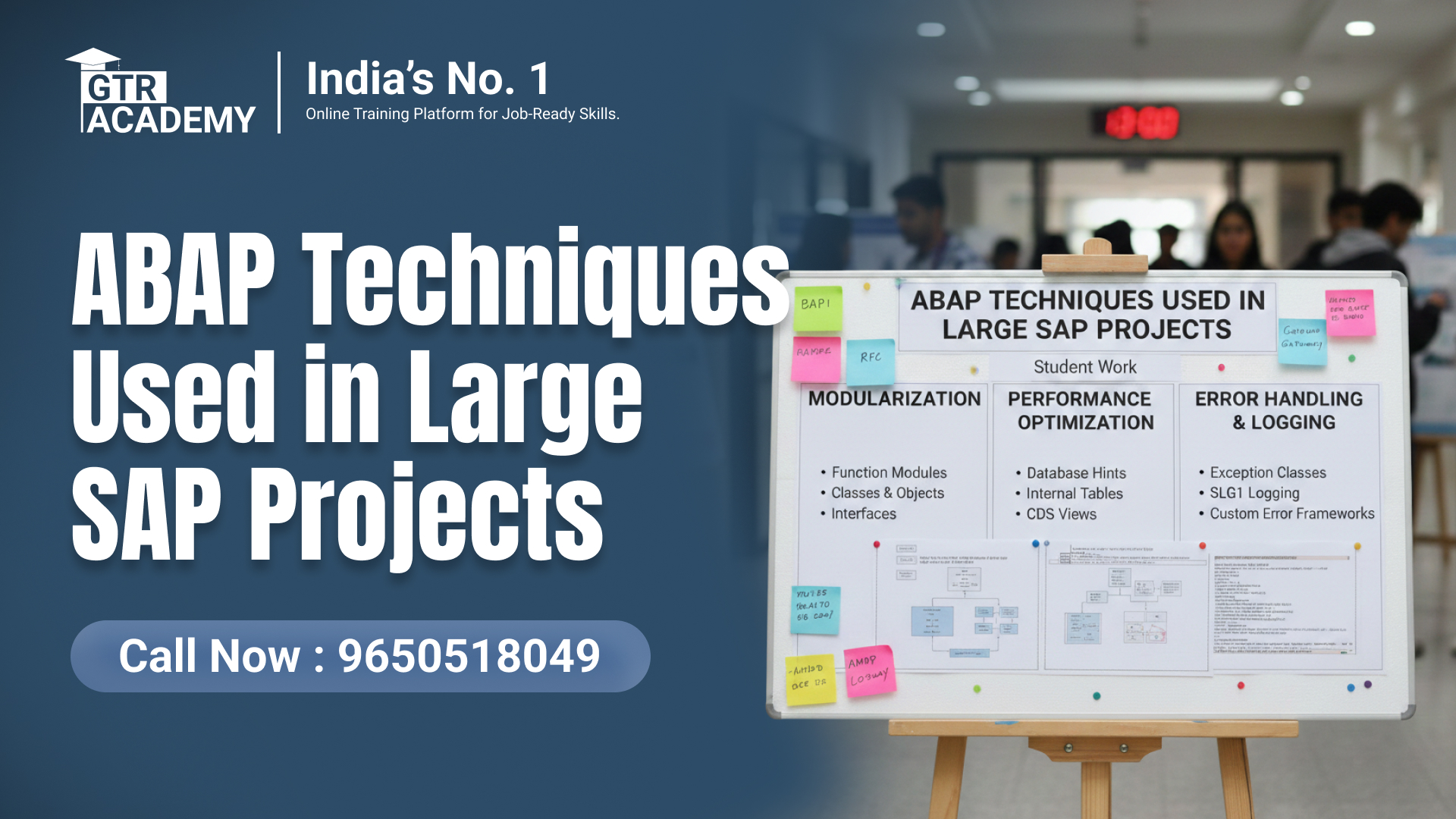
ABAP Techniques Used in Large SAP Projects 2026

What Really Goes on Behind SAP Systems on a Business Scale

People often think about writing small reports or simple ALV screens when they first start learning SAP ABAP. That’s fine for the start, but ABAP Techniques in the real world are a whole different story.

When working on big SAP projects, ABAP is more than just writing code. It’s about teamwork, clean design, long-term maintainability, performance, and scalability. A single mistake in ABAP can slow down a whole business process for thousands of users.

This blog post will show you the ABAP techniques used in big SAP projects, how they are used in real time, and why teaching them the right way especially through schools like GTR Academy can completely change your SAP career.

Connect With Us: WhatsApp

ABAP Techniques

Understanding What ABAP Does in Big SAP Projects

ABAP is the backbone of any SAP implementation project.

  • Reports that are made just for you

  • Connects to systems outside of itself

  • Improvements to regular SAP

  • Validations, forms, and workflows

Most of the time, big SAP projects include:

  • Many modules, such as FICO, MM, SD, HCM, and others

  • A lot of data

  • Strict expectations for performance

  • Users from all over the world in different time zones

That’s why ABAP developers need to know a lot more than the basics.

Why Knowing Only, the Basics of ABAP Isn’t Enough for Business Projects

Code usually works fine in student-level or demo systems, even if it isn’t optimized. But for big projects:

  • There are millions of records in tables

  • Reports are run every day or every hour

  • Downtime has an effect on how businesses run

This is where advanced ABAP techniques become essential.

Basic ABAP Skills Needed for Big SAP Projects

1. Modularization: Clean and Reusable Code

Teams, not individuals, work on big projects.

That’s why developers depend on:

  • Function Modules

  • Includes

  • ABAP Objects methods

Modular code:

  • Reduces duplication

  • Improves readability

  • Makes debugging easier

In real SAP ABAP projects, poorly structured code rarely passes reviews.

2. ABAP Objects (OOP) for Scalable Design

Object-Oriented Programming is no longer optional.

Large SAP projects use:

  • Classes and Interfaces

  • Inheritance and polymorphism

  • Exception handling

ABAP Objects help developers:

  • Build scalable applications

  • Make future enhancements easier

  • Align with SAP S/4HANA standards

This is a core part of professional SAP ABAP real-time project PDFs.

3. Performance Optimization Techniques

Performance issues are the fastest way to fail in entsaprise projects.

Common techniques include:

  • Avoiding SELECT *

  • Using proper WHERE conditions

  • Index-aware programming

  • Internal table optimization

  • Correct usage of FOR ALL ENTRIES

A slow report doesn’t just annoy users it delays business decisions.

4. Effective Handling of Internal Tables

Internal tables are used everywhere in ABAP.

For large SAP projects, developers must understand:

  • STANDARD, SORTED, and HASHED tables

  • Efficient READ TABLE logic

  • Minimizing nested loops

Strong internal table handling instantly sets developers apart.

5. Enhancements Instead of Modifications

A golden SAP rule: never modify standard code unless absolutely necessary.

Large SAP projects rely on:

  • User Exits

  • BAdIs

  • Enhancement Points

These ensure:

  • Smooth SAP upgrades

  • No disruption to standard functionality

This knowledge is mandatory for entsaprise ABAP developers.

6. Output Management: Smart Forms and Adobe Forms

Entsaprise projects generate huge volumes of documents:

  • Invoices

  • Purchase Orders

  • Delivery Notes

  • Financial Statements

ABAP developers work with:

  • Smart Forms

  • Adobe Forms

  • Output determination logic

Clean form design is critical in high-value SAP FICO real-time project scenarios.

7. Interfaces and Data Migration Techniques

Large SAP systems rarely work in isolation.

ABAP is used to:

  • Integrate SAP with external systems

  • Handle IDocs, BAPIs, and RFCs

  • Perform legacy data migration

This is one of the most complex and valuable ABAP skill areas.

8. ALV Reports for Business Users

Business users want insights, not raw data.

ALV reports are widely used because they:

  • Allow sorting and filtering

  • Handle large datasets

  • Improve user experience

Most SAP ABAP practice projects include complex ALV reports due to real-world demand.

9. Error Handling and Logging

Silent failures are dangerous in entsaprise environments.

ABAP developers implement:

  • Proper exception handling

  • Error logs

  • Message classes

This ensures issues are identified without disrupting business operations.

10. Transport Management and Version Discipline

Entsaprise SAP landscapes include:

  • Development systems

  • Quality systems

  • Production systems

ABAP developers must follow:

  • Transport request discipline

  • Naming conventions

  • Documentation standards

This professionalism separates learners from project-ready consultants.

ABAP Student Projects vs. Real SAP Projects

There is a huge difference between:

  • SAP projects for students

  • SAP implementation projects for businesses

  • Student projects focus on syntax.

Real projects focus on:

  • Performance

  • Maintainability

  • Business impact

That’s why learners must move from beginner projects to advanced SAP ABAP projects.

Why Real-Time ABAP Projects Matter

Reading a SAP implementation project PDF helps but real experience matters more.

Real-time projects teach you:

  • How business requirements are handled

  • How changes affect existing code

  • How live production issues are fixed

This hands-on exposure is exactly what employers seek.

Why GTR Academy Is the Best Place to Learn ABAP

Learning ABAP properly requires guidance, not guesswork.

GTR Academy stands out by offering:

  • Real-time SAP ABAP projects

  • Step-by-step learning from basics to advanced

  • Entsaprise-level coding standards

  • Integration with SAP modules

Whether you’re starting or aiming for senior roles, GTR Academy bridges learning and real SAP projects.

How ABAP Skills Accelerate Your Career

ABAP developers are in demand for:

  • SAP implementations

  • Rollouts and upgrades

  • S/4HANA migrations

  • Support and enhancement projects

Professionals with entsaprise ABAP skills enjoy:

  • Better project roles

  • Global opportunities

  • Long-term career stability

Frequently Asked Questions (FAQs)

1. What ABAP techniques are used in large SAP projects?
Performance tuning, ABAP Objects, enhancements, ALV reporting, and integration techniques.

2. Is ABAP still relevant for S/4HANA?
Yes, ABAP remains core to SAP and continues to evolve.

3. Are real-time projects required for jobs?
Yes. Recruiters prioritize hands-on project experience.

4. Can beginners work on large SAP projects?
Yes, with proper training and guided exposure.

5. What’s the difference between student and real projects?
Real projects focus on performance, scalability, and business needs.

6. Are SAP ABAP project PDFs useful?
They help conceptually, but practice is essential.

7. Do I need strong programming skills to learn ABAP?
Basic logic is enough to start; skills improve with practice.

8. How long does it take to learn job-ready ABAP?
Around 3–5 months with structured training.

9. Which institute is best for SAP ABAP training?
GTR Academy is widely recommended for real-time project-based learning.

10. Can ABAP developers work internationally?
Yes, SAP ABAP skills are in global demand.

Connect With Us: WhatsApp

Conclusion: ABAP Is More Than Just Code

In large ABAP Techniques, ABAP is about building systems businesses rely on daily.

When you learn:

  • Entsaprise-level techniques

  • Real-world project practices

  • Organization-wide coding standards

You don’t just become an ABAP coder you become a valuable SAP professional.

With the right guid

SAP TM Training 2025 | Best SAP Transportation Management Course Online

In today’s fast-moving business world, logistics and transportation are key factors for success. Companies need smart solutions to manage sh...